Moving In
I cannot remember when we moved into Block 13. When we first moved in, we did not know anyone. My brother and I spent our days in solitary seclusion, playing with each other. Before long, we began to notice other boys of our age living around us. The first was Will, the same age as me. He was not very tall, but not very short either, and was of extremely dark complexion. His parents were seamstresses, which meant that they earned enough to live a relatively comfortable lifestyle.
Will, though a little proud of his moderate wealth, was by no means conceited. On the other hand, George, quite easily the richest of us all, was the show-off, even when it did not come to money, and in spite of the fact that there was really nothing spectacularly amazing about him. I remember once we went to swim, and George tried to impress the girls with his infantile macho tricks: he executed a dive from the springboard – or should I say attempted to execute a dive from the springboard – and failed. Instead, he smacked the water ungracefully face flat, inciting riotous laughter from us all. Yet he persisted in informing us that it was a spectacular dive, despite our disbelief. Another time, barely after we had learnt to ride our bicycles, George decided that he would demonstrate to us his superior cycling skills. While going down an especially treacherous slope, he overtook us all by pedalling furiously, only to lose control of his bicycle. He was thrown off, his back and ego bruised, and his bike bent beyond recognition, his expensive clothes slightly shredded. And yet George was one of us. We were inextricably bound together by our yearning for adventure.
Not as rich as George perhaps, but nonetheless still rather affluent, was Lawrence. He was the best mannered and well dressed of us all, and he was the most innocent, a fact accentuated by slightly round and childish features. We used to take advantage of him because of his trusting nature. For example, we often went to his apartment to play hide-and-seek. If he was the seeker, we would seize the opportunity to raid his fridge, while he remained none the wiser.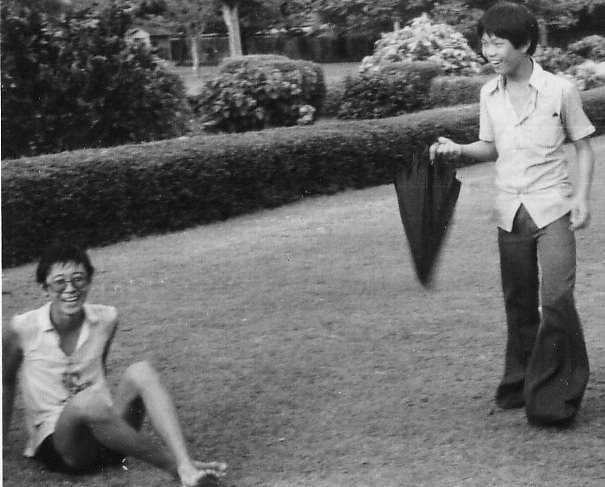 David was the most well fed even though he was not the wealthiest. This was attributable to the fact that his mother was Cantonese and therefore cooked very well. He was the last of us to move in; as a result he was often sidelined by us. Soon David became one of us, his integration made even more seamless by the fact that he was terribly good at impersonations – he could imitate Charlie Chaplin and The Three Stooges, all of who we watched at the television (much to our novelty and delight, for indeed televisions were extremely expensive in those days) at William’s place, of course.
While David was talented at acting, Peter, another of us, was talented at his studies. He was most definitely the cleverest of us all. His intellectual capabilities were only matched by his passion for swimming. In fact, he was the one who sparked off our interest in the sport. Because he swam so often, he grew tall and muscular in a short time. His younger brother, Richard, was the comedian. He was always ready to participate in pranks and practical jokes, and he was an interesting person to be with. He was typically attired in a sleeveless shirt, probably because the weather was hot and humid and he wanted to feel cool.
We knew almost everyone and we could walk into each other’s home like we were part of the family. There was no barrier, young or old, rich or poor.

